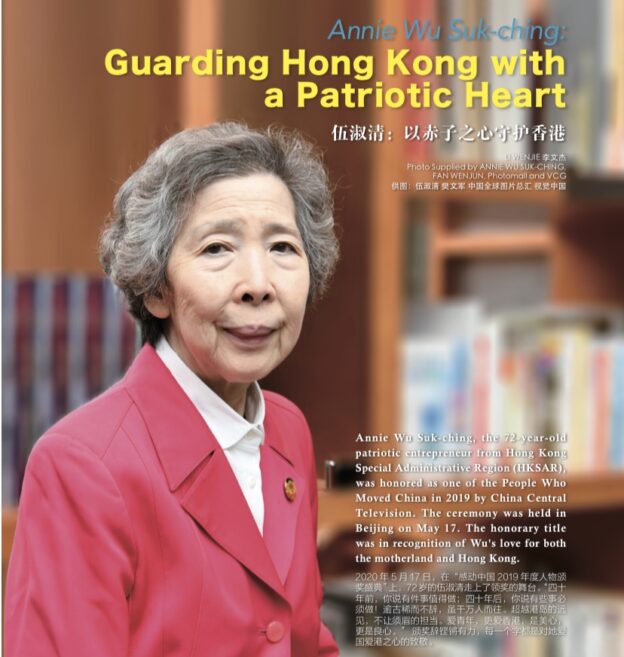
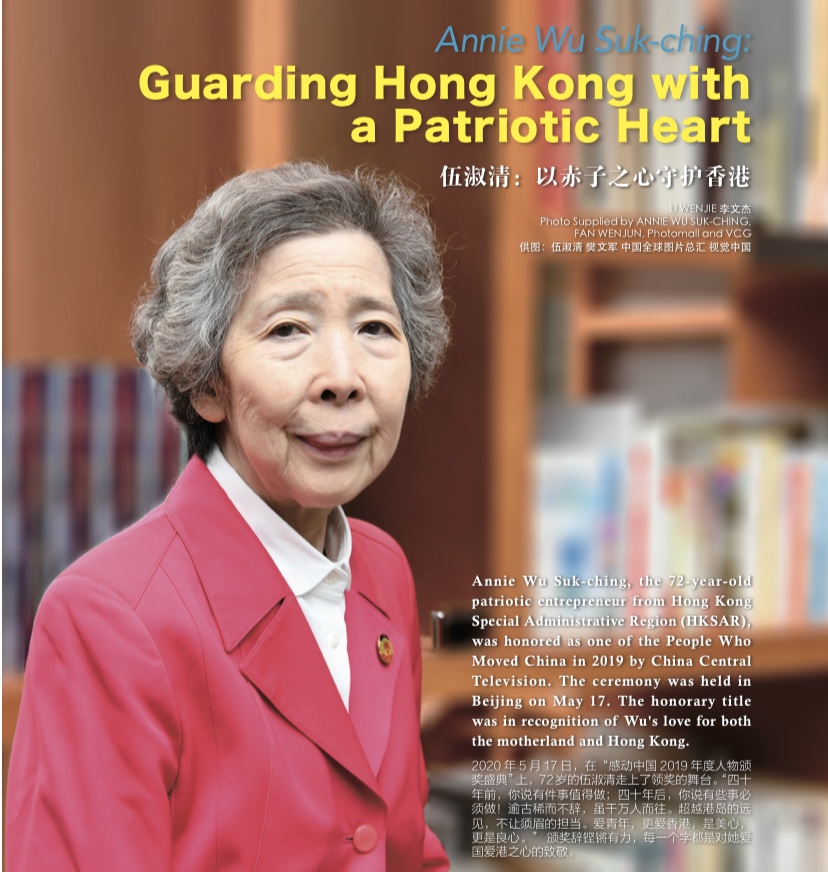
Annie Wu Suk-ching, the 72-year-old patriotic entrepreneur from Hong Kong Special Administrative Region (HKSAR), was honored as one of the People Who Moved China in 2019 by China Central Television. The ceremony was held in Beijing on May 17. The honorary title was in recognition of Wu’s love for both the motherland and Hong Kong.
2020 年 5 月 17 日,在“感动中国 2019 年度人物颁 奖盛典”上,72 岁的伍淑清走上了领奖的舞台。“四十 年前,你说有件事值得做;四十年后,你说有些事必 须做!逾古稀而不辞,虽千万人而往。超越港岛的远 见,不让须眉的担当。爱青年,更爱香港,是美心, 更是良心。” 颁奖辞铿锵有力,每一个字都是对她爱 国爱港之心的致敬。
Wu, the eldest daughter of James Tak Wu, founder of Maxim’s Catering Limited, in Hong Kong, is the founder of Beijing Air Catering, registered as “Sino- Overseas Joint Venture 001” in the Chinese mainland.
With a Chinese dream in her patriotic heart, she is always eager to devote herself to China’s prosperity and development.
Hong Kong has witnessed indiscriminate violence, including riots and acts of terrorism, since the middle of 2019. With a firm patriotic stance, Wu has condemned the violence and she also urged instigators to stop boycotting classes.
In September 2019, as supervisory consultant of the Hong Kong Federation of Women (HKFW), Wu and Pansy Ho Chiu-king, President of HKFW, spoke on behalf of HKFW — to provide a “fact-based perspective” of what happened in Hong Kong, and to “show the world the real situation in Hong Kong” — during the 42nd meeting of the UN Human Rights Council held in Geneva.
National Security Legislation ‘Very Necessary’ 中央就香港维护国家安全立法是人心所归
On May 28 this year, the 13th National People’s Congress (NPC), during its third session, adopted the NPC Decision on Establishing and Improving the Legal System and Enforcement Mechanisms for Safeguarding National Security in the Hong Kong Special Administrative Region.
On June 18, the draft law on safeguarding national security in Hong Kong was submitted for deliberation to the 19th session of the Standing Committee of the 13th NPC.
The Law of the People’s Republic of China on Safeguarding National Security in the Hong Kong Special Administrative Region was passed unanimously on June 30 at the 20th session of the Standing Committee of the 13th NPC, and took effect at 11:00 p.m. local time the same day upon its promulgation by the HKSAR’s government in the gazette.
The legislation is “very necessary,” Wu says. “Although Article 23 of the Basic Law of the Hong Kong Special Administrative Region of the People’s Republic of China stipulates the HKSAR shall enact national security laws on its own, the HKSAR’s legislature has failed to introduce such laws. Maintaining Hong Kong’s long-term prosperity and stability needs support from China’s central government … It is a must for China to enact a law on safeguarding national security in Hong Kong. The central government’s support is the strong backup for Hong Kong to overcome all difficulties,” Wu says.
China, she adds, must interpret the law well to ensure the law is implemented well. “We should use a way acceptable to Hong Kong residents to explain the purpose and content of the law and clear up their misunderstanding. We should make them understand the law protects their basic rights,” Wu says.
The HKSAR government should unite patriotic groups and individuals to publicize relevant information about the law in schools and communities, she suggests.
The HKSAR government announced the National Anthem Ordinance was published in the Gazette and took effect on June 12. To promote implementation of the ordinance, Wu suggests training should be organized for principals and teachers of kindergartens, primary and middle schools and colleges and universities.
“Children in Hong Kong should start to know about their country and respect the national flag in kindergarten … Singing the national anthem is not enough, they should also understand the profound meaning of it,” Wu says.
‘We Are Chinese’
“要认识到自己是中国人”
Many young people were involved in the riots and chaos in Hong Kong. Wu believes these young people have a problem in recognizing their identity, and behind this lies a big problem in Hong Kong’s education system.
“When I studied at schools in the 1950s and 1960s, we had classes in Chinese history and culture. Many teachers were from Beijing and Guangzhou, and they taught us to love our country,” Wu recalls.
“Since Hong Kong’s return to China, some important courses have been canceled. The subject of Chinese history no longer exists in middle schools, and it is just included in the liberal arts education. Some teachers themselves don’t really understand Chinese history, and they fail to keep up with the times, in terms of understanding the development of the mainland. So, they pass on negative thoughts to their students. Under that circumstance, it is hard for Hong Kong youth to have a sense of identity and belonging,” Wu says.
That situation must be changed soon, Wu says. “We must foster children’s sense of nationhood and sense of identity starting in kindergarten … They should know the national anthem and respect the national flag. They should also know that they are Chinese who live in Hong Kong.
“The central government has done a lot to support Hong Kong in the past 23 years. Hong Kong people, especially those who work in education, should be aware of that,” she adds.
‘Seeing Is Believing’
“百闻不如一见”
In recent decades, Wu has promoted exchanges and cooperation between the mainland and Hong Kong, and she has established an education fund to help Hong Kong youth have a better understanding of China’s history and culture.
Wu established the Hong Kong Chinese Teenagers Historical and Cultural Education Foundation in 1998. Since then, the foundation has organized more than 10,000 Hong Kong students to visit the mainland.
Wu established the Chinese Foundation Secondary School in 2000. Throughout the years, she has stressed that education should be rooted in Chinese culture, and that education should broaden one’s international horizons. In 2009, Wu led Hong Kong students to watch the flag-raising ceremony in Tian’anmen Square, in Beijing.
When she served as a member of the National Committee of the Chinese People’s Political Consultative Conference (CPPCC), and as a member of the Standing Committee of the CPPCC National Committee, Wu suggested the need to strengthen patriotism through education in Hong Kong. She suggested that could be accomplished by organizing educational-exchange activities between the mainland and Hong Kong, by improving Hong Kong teenagers’ understanding of national conditions and the Basic Law, and by strengthening the national identity of Hong Kong’s young people.
“Many teenagers from Hong Kong felt moved and impressed when they visited mainland cities. Seeing is believing. We should use people-to-people exchanges to influence teenagers in Hong Kong, help broaden their horizons and increase their sense of national identity and sense of pride,” Wu once suggested.
She has also suggested strengthening communications and exchanges between teachers in the mainland and Hong Kong. “Teachers are the engineers of the human soul. Teachers’ cognition of the country and their national identity have a direct impact on the growth of the next generation. Only when teachers have a full and true understanding of the national conditions, can they educate and guide their students in a correct way,” Wu says.
When talking about the impact of family education and school education on Hong Kong’s teenagers, Wu uses herself as an example. “My granny was a farmer. She taught us that we should cherish food and maintain a good temper. My mother told me that I should write family letters to her in Chinese. My teachers made me learn more about our country, and be more patriotic. Family education fosters a person’s character, while school education plays a big role in fostering patriotism among children,” Wu says.
When it comes to Hong Kong’s future, Wu says, “I believe the central government will offer Hong Kong more support, to ensure its continued prosperity and stability.”
Women of China 2020.7